Image1
Pick your own Language - Refresh the page for backing to the Original Language
  • Narrow screen resolution
  • Wide screen resolution
  • Wide screen resolution
  • Increase font size
  • Default font size
  • Decrease font size

Meg, We Hardly Knew Ye


By Mark Renz


C. megalodon, known as the genus Carcharodon by some fossil shark researchers and Carcharocles by others, was no doubt one big, mean eating machine. At 60 feet, it was nearly as long as two school buses, and weighed as much as 400 professional football linebackers at 250 pounds each. It's "slice of pie" shaped teeth exceed seven inches, and with Ford Explorer-sized bites it may have been enough to make short order of the largest whales. But what did this shark, more commonly referred to as Meg, look like?
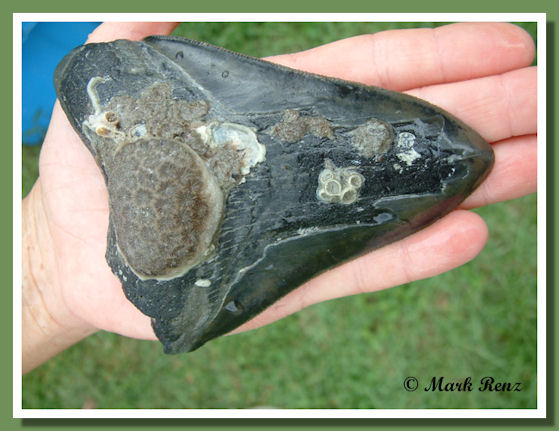

Mega1.jpg

In spite of this massive creature's global domination for millions of years, we know very little about it. All we have to offer us a backwards glimpse are lots of teeth and a few vertebrae, as well as bite marks it left on the bones of large marine mammals. No one has ever found a complete skeleton of an adult Meg, although 150 vertebrae from a 30-foot juvenile were recovered over 130 years ago near Antwerp, Belgium.

So what would Meg have looked like? Some researchers who place the shark in the genus Carcharodon think it would have resembled a great white shark, and therefore would have looked a lot like today's toothy critter. Those who lean towards Carcharocles as the genus believe Meg might have more closely resembled an extremely large sand tiger shark.

Bretton W. Kent, author of "Fossil Sharks of the Chesapeake Bay Region" believes that if Meg is more closely related to sand tiger sharks, the relationship is largely irrelevant for determining body shape. "I'm a functional morphologist by training and argue that the constraints on shape are so severe for an axial swimmer (i.e., that flexes the body to provide propulsion) of this size that a sand tiger style of body is physically impossible," says Kent. "Sand tigers have an acceleration body form and use drag to displace water when swimming. Displacement swimmers need to move a water mass equivalent to 3-4 times their body mass with each stroke of the tail to swim by this mechanism." Kent says that the problem arises at really big sizes like that of Meg.

"This problem is based on classic biological scaling," he says. For objects of similar shape, doubling the length causes surface area (e.g., fins) to increase four times and volume (i.e., mass) to increase eight times. Consequently, a really large sand tiger would need enormous fins to offset the tremendous increase in mass. Unfortunately, these fins would also generate an enormous amount of nonproductive drag that would impede swimming.

"The only way large axial swimmers have evolved is to switch over to a cruising body form that generates propulsion by lift rather than drag," says Kent. "Cruising fish need only displace a fraction of their body weight when swimming, relying instead on increasing the speed, rather than the mass, of the water over the tail. All of the large marine, axial swimmers (tunas, porpoises, whales, great white, mako, basking and whale sharks) use a cruising body form. As far as we know, no really large marine animal with an acceleration body shape has ever evolved. They all appear to be cruisers."

Kent suggests that a more reasonable shape would be that of a basking or whale shark.

"The front ends of these sharks are rather different, but the back ends (where drag is a real problem) are remarkably similar," he says. "The caudal fin is nearly lunate, the second dorsal and anal fins are tiny, and there is a caudal keel on each side of the caudal peduncle. The same pattern occurs in other large axial swimmers (e.g., bluefin tuna, billfish, whales, great whites & makos), not because they are related to each other, but because they're simply big. Again the front ends may be different, but the back ends have the same low drag shape.

"I personally use basking sharks as the basis for my reconstruction of the Meg body shape," adds Kent. "Robustness of the body would be due to the interaction between limits on muscle-based underwater swimming speeds and the proportion of white muscle for burst swimming in the body."

Mega4.jpg
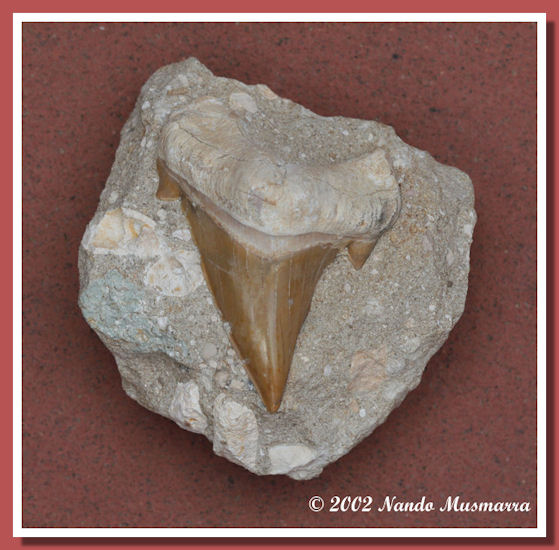
Otodus obliquus tooth from Morocco

Although no one can be certain what Meg looked like based on its fossil teeth, there is ample proof that the teeth themselves were constantly evolving. One of the earliest stages of Meg -- according to "Carcharocles" followers, is Otodus Obliquus, an ancestor of 60-50 million years ago. Otodus had large, thick teeth up to 4 inches with cusplets and no serrations. The shark may have reached 30 feet in length and likely dined on large fish.

Fossil shark specialist David J. Ward says that approximately 51 million years ago in the early Eocene, Otodus teeth developed very fine folds in their cutting edges. "Serrations appeared, at first low, on either side of the crown by the cusplets, then spreading up close to the tip," said Ward. "This first form is called Carcharocles aksuaticus."

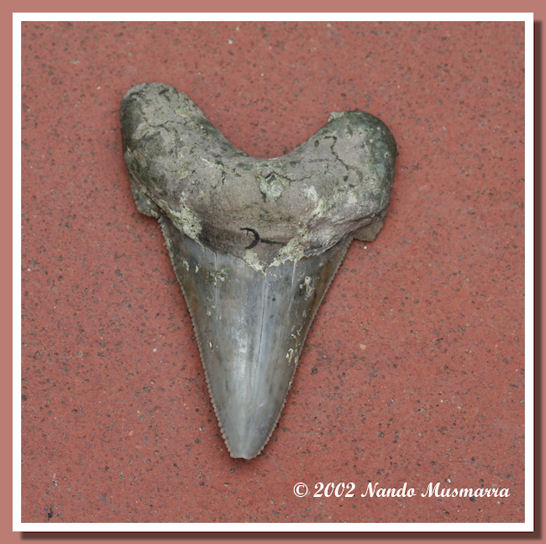
The next species is Carcharocles auriculatus of the late to middle Eocene (50-42 mya). As its name implies, it has large, rather ragged lateral cusps, and even serrations that almost, but not quite reach the tip of the crown. Fairly recently, the name C. poseidoni has been used for the first of the Carcharocles lineage that has an almost fully serrated crown. This is a late Eocene (35-30 mya) species.
 

Mega5.jpg

Eocene , North Carolina - Foto e ritrovamento di Nando Musmarra

The name Carcharocles angustidens is used for a range of shapes as the crown widens and becomes more triangular in the Oligocene through early Miocene (35-22 mya). The form where the lateral cusps are disappearing into the sides of the crown-proper -- seen in the late Oligocene and through the middle Miocene (35-14 mya) is called C. chubutensis by some and C. subauriculatus by others. A morpho species of chubutensis lived into the late Miocene (5 mya).

"The final stage, the star of the show, occurs when, in adults, the lateral cusps are lost, imperceptible in the base of the wide crown," says Ward. "This is C. megalodon." Most of the oldest Meg teeth date back to about 18 mya, but Ward has an Oligocene tooth from the Chandler Bridge Formation of Summerville, SC.

When trying to determine which of Meg's ancestors you have found, Ward emphasizes that you have to first sort out exactly what constitutes a Meg.

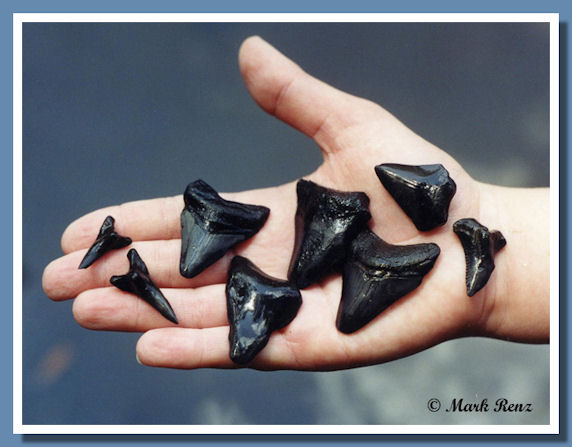
"There are two conflicting classifications," he says. "The first - morphospecies - is just shape based. Thus, if it is big, with no lateral cusps, it is a Meg. The other, a more scientific approach, attempts to get closer to a zoological species. The name used is based only on the adult shape. In the Miocene, and possibly in the latest Oligocene, all adults have lost their cusps, and are all, by definition, Megs. The problem with using the former, is that, for instance, a Carcharocles, living in the Middle Miocene starts life as an angustidens, passes its "teens" as chubutensis, and is a Meg as an adult."

Mega2.jpg

Ward says that all the names given to this shark are not too important. They are just ways of expressing stages of evolution in the teeth of a giant shark.

"One thing you must understand is that we are talking about a lineage -- a single undivided branch of the family tree stretching from the Paleocene to the Pliocene -- not a series of separate species. There was only one Carcharocles present at any one time, so a tooth, or for that matter the whole shark, from the USA will be virtually indistinguishable from one, say, from Europe. How many species you divide this lineage into, is not really important. Names are artificial. What is important is to understand that we are talking about the family tree of a single giant shark, that changed gradually through time. "
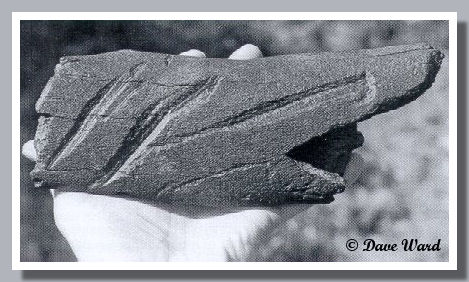

Mega3.jpg

Photo by Dave Ward

© Mark Renz


Mark Renz hunts for Meg teeth in his home state of Florida, where he and his wife Marisa operate a fossil guide service. Signed copies of his book, "MEGALODON: Hunting the Hunter" are available at:

www.paleopress.net/index.htm

Si ringraziano Mark e Marisa Renz per il permesso di pubblicare l'articolo e le fotografie
Quest'articolo è stato già pubblicato su Fossil News


Animated-Digsite From the Dig Sites


TitleAuthor
Campagna Autunnale 2009 Scavi Paleontologici sul Monte San Giorgio Sergio Pezzoli
Cassina 2008 - Per chi ha la natura nell'anima Sergio Pezzoli
Cassina 2009 - Tra scavi triassici e delizie gastronomiche Sergio Pezzoli
Giants In The Storm - La Belle Site in Florida Nando Musmarra
I Dinosauri Della Porta Accanto - L'Arlington Archosaur Site Diana Fattori
I Dinosauri di Galve, Spagna Diana Fattori
Il Monte Generoso... a casa dell'orso Sergio Pezzoli
Lee Rex, l'Ultimo dei Tirannosauri Nando Musmarra
Polly, il Plesiosauro che Preserva l'Embrione Fossile Nando Musmarra
Scavi Cassina (CH) - Ritrovati Embrioni Fossili Gianluca Toppi
Scavi paleontologici 2011 sul Monte San Giorgio Rudolf Stockar
The El Fabar Ordovician Tunnel (Language: ENGLISH) Nando Musmarra - Wendell Ricketts
Urs Oberli - L'Uomo che Sussurrava ai Saurichthys Sergio Pezzoli


ButtonFamous Famous Fossil Locations


TitleAuthor
Ashfall Fossil Beds - La Pompei delle praterie Nando Musmarra
Besano/Monte San Giorgio - Mari Senza Frontiere Diana Fattori
Bolca Aquarium in Stone - Big guys swam here! (Language: ENGLISH) Diana Fattori
Fabar, SPAIN - Il Tunnel Ordoviciano del Fabar Nando Musmarra
Kemmerer - Tutta colpa dei pipistrelli L'Onychonycteris finneyi Nando Musmarra
La Voulte-sur-Rhone - La Piovra delle Ardèche Nando Musmarra
Mount Maiella - Fishing in the Abruzzo Mountains (Language: ENGLISH) Diana Fattori
Ribesalbes - Le Salamandre, i Tritoni e gli altri abitanti del Lago Pietrificato Nando Musmarra
SPAIN: The Dinosaur Coast (Language: ENGLISH) Diana Fattori & Nando Musmarra
ITALY: The Dunarobba Fossil Forest (Language: ENGLISH) Diana Fattori & Nando Musmarra


geology-vulcan   Geology


TitleAuthor
Devil's Tower - Incontri ravvicinati con la torre del Dio cattivo Nando Musmarra
La Fluorita de Blanchard mine (Language SPANISH) Diana Fattori
Las Canteras De Yeso Del Verdegás (Language: SPANISH) José Ramón Pastor Aliaga
Le Miniere d'Argento di Tellure Diana Fattori
Meteoriti e Olio Santo Nicola Cardaci
Titanite Crystals from the Mirage Trail (Language: ENGLISH) A.R. Kampf - E.C. Wilson - G.R. Rossman
Viaje al Centro de la Tierra - Las Cavernas de Carlsbad (Language: SPANISH) Nando Musmarra


ButtonShow  Shows


TitleAuthor
Bologna Mineral Show 2009 Sergio Pezzoli
Bourse Sainte-Marie aux Mines - In Alsazia tra Aquile e Cicogne Sergio Pezzoli
Fiera Sainte Marie 2007 - (Language: ENGLISH) Diana Fattori & Nando Musmarra
Mostra Minerali, Fossili e Conchiglie Roma 2011 - Intervista a Vincenzo Nasti Nando Musmarra
The Archaeopteryx Exhibit at the Munich Show (Language: ENGLISH) Diana Fattori & Nando Musmarra
The Denver Fossil and Mineral Show (Language: ENGLISH) Diana Fattori & Nando Musmarra
World's Best Fossil Shows Calendar Nando Musmarra


ButtonScientific Let's Go Scientific


TitleAuthor
Carlo Linneo - Il Principe dei Botanici Pia Giorgetti
Exceptional preservation of embryos in the Saurichthys (Language: ENGLISH)
Silvio Renesto - Rudolf Stockar
Meg, We Hardly Knew Ye (Language: ENGLISH) Mark Renz
MEGALODON: Hunting the Hunter (Language: ENGLISH) Mark Renz
New Excavations in Tha Cassina Beds - Preliminary Report (Language: ENGLISH) Silvio Renesto - Cristina Lombardo - Rudolf Stockar
The Largest Pliosaurid from North America (Language: ENGLISH)
Dean R. Lomax
The Middle Triassic Cassina beds (Language: ENGLISH)
Rudolf Stockar
Una Nuova Pianta Fossile - Elatocladus cassinae Sergio Pezzoli


ButtonALittleBit A Little Bit of Everything


TitleAuthor
Aguzzate La Vista Nando Musmarra
Aguzzate La Vista - Soluzioni Nando Musmarra
Aguzzate La Vista 2 - La rivincita!!! Nando Musmarra
Aguzzate La Vista 2 - Soluzioni Nando Musmarra
GPS Jurassic Coördinates (Language: ENGLISH) Nando Musmarra & Diana Fattori
GPS Località Giurassiche Nando Musmarra
I Fossili nel ‘600 e nel ‘700: Vis Plastica, Ludi Naturae, Diluvi e Catastrofi Loana Riboli
Il Saurolo Emanuele Maritan
PaleoCruciverba-01 Nando Musmarra
PaleoCruciverba-01 - Soluzioni Nando Musmarra
The Gargantuan Fossil Dinner (Language: ENGLISH) Diana Fattori & Nando Musmarra
Una Cena Pantagruelica Diana Fattori & Nando Musmarra


ButtonEducational Educational / Didattica

TitleAuthor
Germany - Fossil of the Year 2008 - Parapuzosia sepenrandensis (Language: ENGLISH) Nando Musmarra
La Carica dei Ceratopsidi Diego Sala
Storie di Fossili Ceresini - 1 - Un Giacimento Paleontologico Unico al Mondo Paola D'Agostino
Storie di Fossili Ceresini - 2 - Definiamo un Fossile Paola D'Agostino
Storie di Fossili Ceresini - 3 - I Nostri Straordinari Fossili Paola D'Agostino
Storie di Fossili Ceresini - 4 - I Principali Rettili Rinvenuti Paola D'Agostino


ButtonTraveling PaleoTraveling


TitleAuthor
All'Inseguimento del C. Megalodon a Venice Beach Nando Musmarra
Corno della Paura - Una passeggiata paleontologica sul Monte Baldo Sergio Pezzoli
Dinosauri alla coque - Le uova di dinosauro al Museo-Parco di Meze, Francia Diana Fattori
Il Geosito di Dunarobba - Occasione Scientifica e Turistica Lucilia Gregori - Federico Famiani
La Fluorite della Blanchard Mine Diana Fattori
La Piccola Chiesa Nella Prateria e gli Oceani Fossili del Kansas Nando Musmarra
The Mermaid Song - The Taulanne Sirenian Site in France (Language: ENGLISH) Diana Fattori & Nando Musmarra
WYOMING: Dove i Cowboys Cavalcano i Dinosauri Diana Fattori


ButtonFieldTrips Field trips


TitleAuthor
Mom, There is a Trilobite in My Sandwich!!! (Language: ENGLISH) Diana Fattori & Nando Musmarra
A la persecución del C. Megalodon en Venice Beach (Language: SPANISH) Nando Musmarra
Cadzand, squali nella nebbia Nando Musmarra
Germania, denti al doppio (s)malto Nando Musmarra
Jurassic Colours Looking for Ammonites in the German Braunjura (Language: ENGLISH) Diana Fattori & Nando Musmarra
Sogno di Una Notte di Fine Estate: Moto Ondoso in Aumento Nando Musmarra


ButtonIchnology Ichnology


TitleAuthor
Il "Centro de Interpretación Paleontológica de La Rioja" di Igea Nando Musmarra
La Rioja 1 - L'Era del Peladillo - L'Albero Fossile di Igea Nando Musmarra
Münchehagen: l'Europasaurus e le Tracce di Dinosauro della Bassa Sassonia Diana Fattori
Passi da GIGANTE- Le Supertracce di Sauropode di Plagne, Francia Diana Fattori


ButtonArcheology   Archeology


TitleAuthor
Il Parco della Preistoria di Teverga, Spagna Diana Fattori
L' Arte del Paleolitico - Il cavallo, il bisonte e l' uro Loana Riboli
L'Evoluzione Umana interpretata da Stefano Cuzzilla Stefano Cuzzilla - Diana Fattori


ButtonMuseums PaleoMuseums


TitleAuthor
Back to the Past -il Nuovo Museo dei Trilobiti a Cancun Enrico Bonino
Il Bürgermeister Müller Museum di Solnhofen Nando Musmarra
Il Museo di Storia Naturale di San Gallo (CH) Sergio Pezzoli
Il Wyoming Dinosaur Center e l'Archaeopteryx N.10 Diana Fattori
La Costa dei Dinosauri Diana Fattori
Le Muséum National d'Histoire Naturelle de Paris Paola D'Agostino
Sulle orme di Barnum Brown: i dinosauri del Sauriermuseum di Aathal (CH) Diana Fattori
The Black Hills Institute
Diana Fattori


ButtonReviews PaleoReviews


TitleAuthor
Ammoniti - Un Viaggio Geologico Nelle Montagne Appenniniche Nando Musmarra
Archaeopteryx di Peter Wellnhofer Diana Fattori
Archaeopteryx: the Icon of Evolution (Language: ENGLISH) Diana Fattori
HOW TO DRAW DINOSAURS Diana Fattori
Iceman Photoscan Diana Fattori
Il Cervino è Africano? Storia dell'Evoluzione Geologica delle Alpi Sergio Pezzoli
MEGALODON - Hunting the hunter Nando Musmarra
Nomochirus N.1 - Clypeasteroida Diana Fattori
Nomochirus N.2 - Cidaroida Diana Fattori
The DINOSAURIA Diana Fattori
TRILOBITI - IL libro del Museo Enrico Bonino & Carlo Kier


ButtonArt PaleoArt


TitleAuthor
Chuck Bonner PaleoArt (Language: ENGLISH)
Chuck Bonner
Elisabeth Daynès - Premio Paleoart Lanzendorf 2010 Nando Musmarra
Fabio Pastori PaleoArt (Language: ENGLISH) Nando Musmarra
La PaleoArte di Davide Bonadonna Davide Bonadonna
La Paleoarte di Diego Sala Diego Sala
La PaleoArte di Matteo Bacchin Matteo Bacchin
La PaleoVetrina di Fabio Pastori Fabio Pastori
La Vetrina di Enrico Bonino Enrico Bonino
La Vetrina di Stefano Cuzzilla Stefano Cuzzilla
Le Paleo Sculture di Marco Tacchi Marco Tacchi
Loana Riboli won the Honor Mention at IPIC Awards (Language: ENGLISH)
Nando Musmarra
Paleoart by Loana Riboli Loana Riboli
PaleoHumor by Bill Palmer Global Administrator
Russell J. Hawley PaleoArt (Language: ENGLISH) Nando Musmarra


ButtonNature Nature


TitleAuthor
Il Tuatara: l'Ultimo dei Rincocefali Sergio Pezzoli
L'Arizona Sonora Desert Museum Diana Fattori
La Latimeria Sergio Pezzoli
MICROPOLIS - La Città degli insetti Diana Fattori
Un gastéropode terrestre français très commun: Cepaea nemoralis (Linnaeus, 1758) - (Language: French) Coco Chataigner  


ButtonColllections Fossil Collections

TitleAuthor
Dalla collezione Nonno Augusto Nando Musmarra
La collezione di George W. Powell Jr. Nando Musmarra
La Collezione di Ron Seavey Nando Musmarra


Navigation by WebRing.